Evaluation & Evidence
Score the evidence, not the impression.
Give reviewers the original response, the same written standard, and a clear place to record their judgment. Every score stays connected to the work that supports it.
AI can summarize and suggest. A named evaluator records the score; people make the decision.
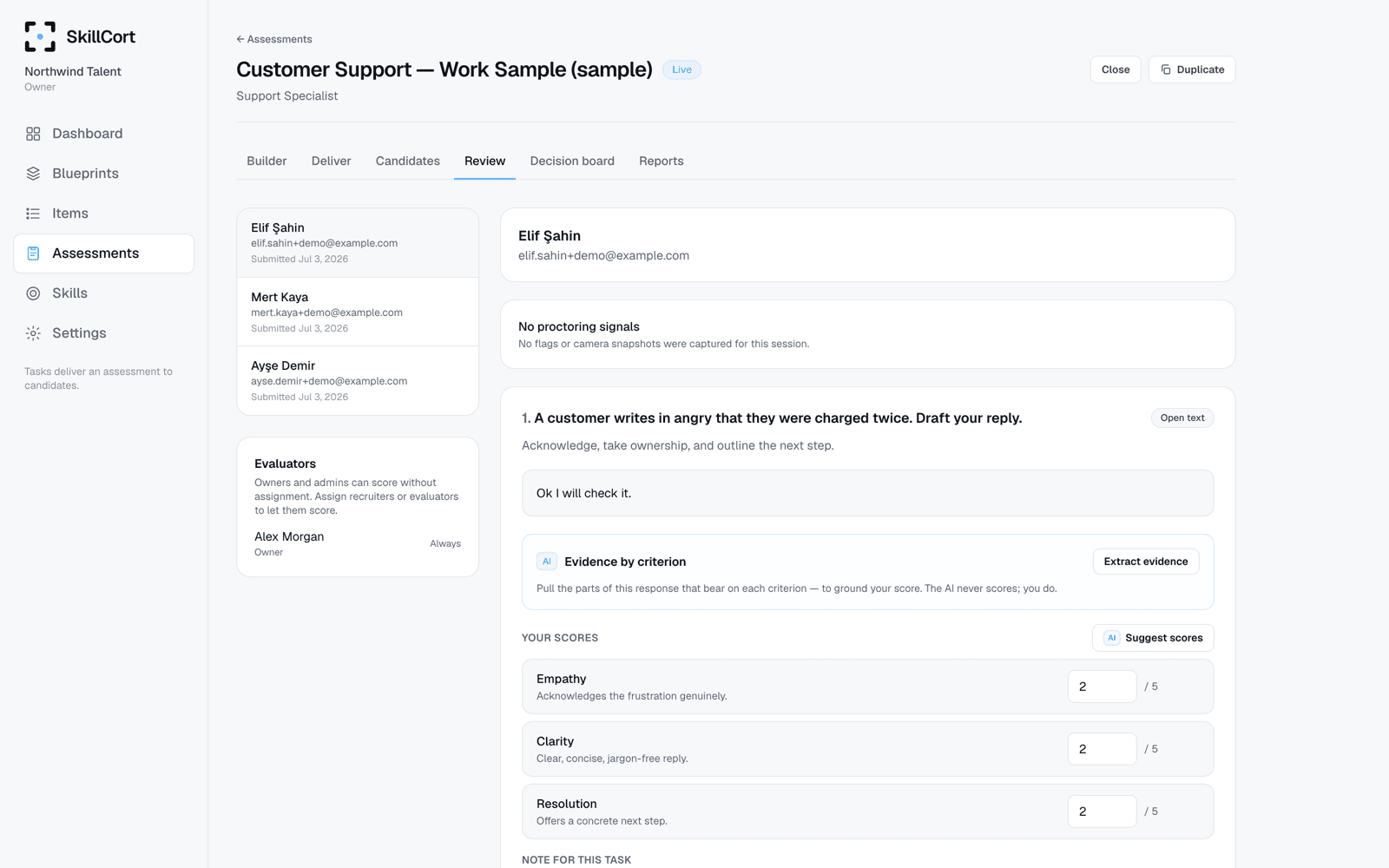
A review workspace where the standard and the proof stay together
Choose the described level that matches the work.
Matrix rubrics pair each criterion with written descriptions at each level. Reviewers select the behavior they can see instead of relying on a private interpretation of a number.
- Criterion-by-level descriptions
- Observable scoring anchors
- Explicit criterion weights
- Shared across evaluators
Use direct numeric entry where it fits.
Classic rubrics keep the same criterion structure and weighting while allowing an evaluator to enter a numeric score directly.
- Numeric score per criterion
- Criterion definitions
- Weighted combination
- Evaluator notes
Keep automatic and human scoring rules explicit.
Keyed items can produce an automatic score. Responses without an answer key remain unscored for review; in the role-fit rollup, an available human rubric score is used instead of the task's automatic fit.
- Answer-key scoring
- Null means needs review, not zero
- Rubric score used for role-fit when available
- Scoring method visible in the builder
Keep independent judgments attributable.
More than one evaluator can score the same response. Each score is stored with its named evaluator and timestamp, then averages within each criterion before weights apply.
- Named evaluator attribution
- Timestamped scoring
- Per-criterion averaging
- Individual judgments remain visible
Keep candidate work as the source of truth.
Written answers, uploaded files, recordings, and interview or simulation transcripts remain available for review rather than being replaced by a summary.
- Written task outputs
- Uploaded deliverables
- Audio and video responses
- Interview and simulation transcripts
Store the reasoning beside the score.
Notes attach to the task evaluation so a reviewer can explain what they observed and why the work matched a particular criterion or level.
- Task-level review notes
- Reasoning beside the numbers
- Named reviewer context
- Available in the review record
Review session events without turning them into a score.
When integrity controls are enabled, their events appear as a separate timeline. Reviewers interpret that context; the events do not lower the assessment score or reject a candidate automatically.
- Reviewable event timeline
- Source evidence kept attached
- Separate from skill scoring
- Human resolution
Carry the evidence into the handoff.
Printable reports summarize the scoring, reviewer context, integrity resolutions, and final human decision. Reviewers can return to the workspace for original media and conversation evidence.
- Printable result summary
- Weighted scoring methodology
- Reviewer attribution
- Decision and integrity context
Use AI to reduce reading time without transferring judgment.
Evidence extraction
AI can organize relevant passages from a long response against the rubric criteria for a reviewer to inspect.
Draft score suggestions
Criterion-level suggestions stay outside the evaluator score until a person explicitly applies or replaces them.
Transcript review
Interview and simulation support works from the candidate's words in the transcript, not facial expression or vocal emotion.
Generation provenance
AI-assisted evaluation outputs carry model and version provenance so the assisted step can be traced later.
From response to role-fit, every step is explainable.
Evaluation begins at the response, not at an abstract score. Reviewers apply a frozen rubric snapshot, record criterion judgments, and keep notes with the task evidence.
Evaluator scores average within each criterion, criteria combine by rubric weights, and task evidence rolls through skill and section weights into role-fit. The Decision Board can then compare the result without hiding how it was produced.
See candidate comparisonOpen the response
Read or play the original candidate work and its task context.
Apply the rubric
Score each criterion against the shared definitions or level descriptions.
Record the reasoning
Attach evaluator notes so the judgment travels with the score.
Roll up transparently
Combine criteria, skills, and sections using their explicit weights.
Evaluation controls that keep review consistent and inspectable
Shared rubrics
Classic and matrix rubrics give every evaluator the same criteria and explicit weights.
Source evidence
Original responses, files, recordings, transcripts, and notes remain available in the review workspace.
Named judgment
Scores are stored with the evaluator who recorded them and the time they were submitted.
AI as assistance
Summaries and score suggestions help reviewers orient; they do not decide or write a score independently.
Move from scattered opinions to reviewable judgment
Unstructured evaluation
- A single score with no visible basis
- Reviewer comments stored in another tool
- Different standards for different candidates
- AI output treated as an answer
- No clear path back to the original work
Evaluation & Evidence in SkillCort
- Criterion scores tied to a shared rubric
- Notes kept beside the response
- Named evaluators and explicit weights
- AI suggestions separated from human scores
- Every result traceable to source evidence
A defensible score is not just consistent math. It is a judgment whose standard, evidence, and owner can all be inspected.
Keep AI on the reviewer side of the line.
AI can shorten the path through a long answer or transcript, but SkillCort keeps suggestions structurally separate from evaluator scores. A person must apply or replace a suggestion, and candidate decisions remain human-owned.
- No AI-written candidate decision
- No automatic rejection
- Original response stays visible
- Criterion-level suggestions
- Human apply-or-replace step
- Model and version provenance
Evaluation and evidence questions
Classic rubrics accept a numeric score per criterion. Matrix rubrics define scored levels with a written description for every criterion-level combination. Both support criterion weights and evaluator notes.
Scores from multiple evaluators average within each criterion. Criterion averages then combine using rubric weights before tasks roll up through mapped skills and section weights.
It remains unscored and needs review; it is not silently treated as zero. In the role-fit rollup, a human rubric score is used instead of the task's automatic fit when both are available.
No. AI can draft criterion-level suggestions and summaries, but it does not independently write evaluator scores or candidate decisions. A named person reviews the evidence and records the judgment.
Depending on the task, the review workspace can include written answers, uploaded files, audio or video responses, interview and simulation transcripts, evaluator notes, rubric scores, and a separate integrity-event timeline when those controls were enabled. Printable reports summarize the decision record rather than embedding every media type.
Score one real response together.
Bring a task and rubric to a demo. We will follow the original evidence through evaluator scoring, role-fit, reporting, and the final human decision.