Work Samples
See how candidates do the work before you hire.
Give candidates realistic tasks that mirror the role, then carry each submitted response forward as reviewable evidence instead of reducing performance to a quiz score.
Every task maps to a skill and a rubric, so responses become comparable evidence.
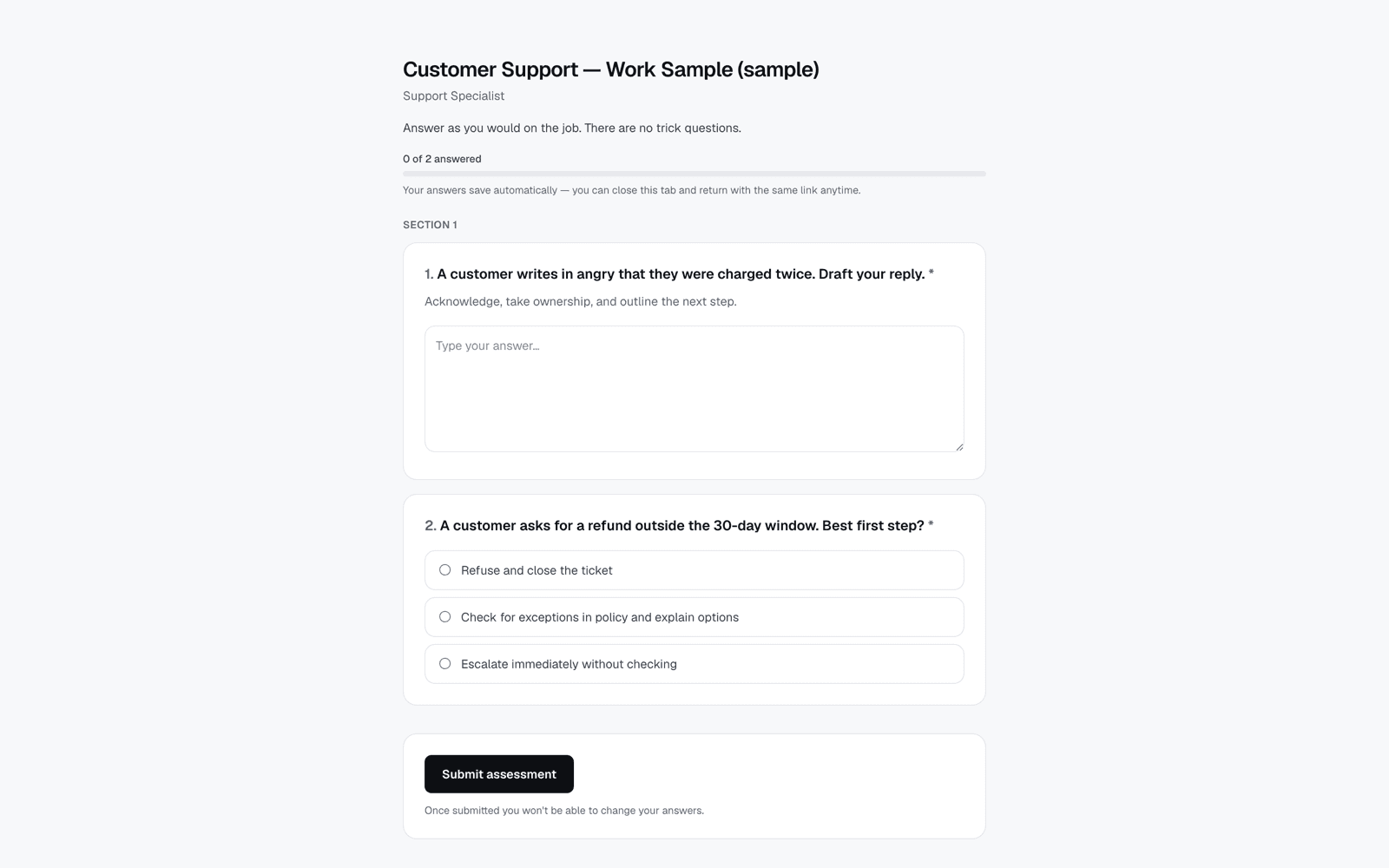
Realistic tasks for the work candidates will actually do
Explore SkillCort OriginalsReproduce a real support queue.
Candidates respond to realistic customer tickets in a structured workspace, so you see tone, accuracy, prioritization, and resolution quality on the actual work.
- Inbound ticket scenarios
- Difficult-customer situations
- Prioritization across a queue
- Tone and accuracy captured per response
Short written cases that mirror the role.
Present a realistic business scenario and ask candidates to analyze, recommend, and justify — evidence of judgment that a multiple-choice item can't show.
- Scenario briefs with context
- Open-ended written analysis
- Recommendation and justification
- Rubric-aligned scoring
Capture spoken communication and judgment.
Collect video or audio responses for pitch, discovery, or explanation tasks. The original recording stays visible as evidence alongside any summary.
- Timed video or audio prompts
- Pitch and discovery scenarios
- Re-take rules you control
- Original recording kept as evidence
Let candidates submit real artifacts.
Ask for spreadsheets, documents, or other deliverables and review them against a rubric — for roles where the output is the proof.
- Document and spreadsheet uploads
- Deliverable-based tasks
- File-type and size controls
- Reviewed against shared criteria
Run structured role-play scenarios.
Design objection-handling and conversation scenarios with evaluator prompts, so assessment-center exercises stay consistent across candidates.
- Objection-handling scenarios
- Branching conversation prompts
- Evaluator observation forms
- Consistent across candidates
Built for the assessments teams run most.
Customer Support Hiring
Evaluate communication, empathy, prioritization, and problem solving through realistic service tasks.
Measured skills
- Written communication
- Empathy
- Resolution quality
- Prioritization
Example tasks
- Ticket response
- Difficult-customer scenario
- Short written case
Expected output
- Skill evidence
- Rubric scores
- Decision-ready comparison
Sales Hiring
Assess objection handling, discovery, and written communication through realistic selling scenarios.
Measured skills
- Objection handling
- Discovery
- Written communication
- Sales judgment
Example tasks
- Objection role-play
- Video pitch
- Follow-up email
Expected output
- Sales signal report
- Role-fit score
- Strength/risk summary
Assessment Centers
Standardize role plays, group exercises, and case studies across a multi-exercise assessment day.
Measured skills
- Analysis
- Communication
- Decision making
- Collaboration
Example tasks
- Case study
- Role play
- Group exercise
Expected output
- Task evidence
- Criterion-level scores
- Reviewer notes
From a realistic prompt to reviewable work.
Choose the response format that best reveals the skill: written work, a recording, an uploaded deliverable, or a structured scenario.
The candidate delivery flow handles instructions and submission; Evaluation & Evidence keeps the response attached to the criteria reviewers use.
See Evaluation & EvidencePick the tasks
Choose work-sample tasks per skill.
Attach rubrics
Pair each task with scoring criteria.
Set the response format
Choose written, recorded, uploaded, or live interaction.
Collect responses
Capture answers, recordings, and files.
Route to review
Keep each submission connected to its criteria.
Everything to run realistic, reviewable tasks
Ticket Simulations
Reproduce a real support queue with realistic inbound scenarios.
Case Studies
Short written cases that reveal analysis, judgment, and clarity.
Video & Audio Responses
Capture spoken communication with the original recording kept as evidence.
File Upload Tasks
Let candidates submit real deliverables reviewed against a rubric.
Role-Play Scenarios
Run consistent objection-handling and conversation exercises.
Connected Evaluation
Carry each response into a criteria-based review workspace.
Evaluation & EvidenceProportional Integrity
Add the right integrity level per task without surveillance.
Integrity & ProctoringSkill-Linked Capture
Tie every response to the skill it measures for comparable evidence.
More than a question bank.
Traditional Test
- Multiple-choice and trivia items
- Measures recall, not the work
- Scores disconnected from the role
- Hard to defend in review
SkillCort Work Sample Tasks
- Realistic, role-specific tasks
- Captures how candidates actually work
- Every response mapped to a skill
- Rubric-scored, reviewable evidence
- Flows directly into the Decision Board
Work samples give teams evidence that's easier to compare, easier to review, and easier to turn into a defensible decision.
Frequently asked questions
Ticket simulations, case studies, written tasks, video and audio responses, file-upload assignments, and role-play scenarios — each paired with a rubric and evaluator form.
No. Tasks run in the browser with a clear preflight, progress, and completion experience designed to keep the candidate flow accessible and low-friction.
Each task can be linked to a rubric. Reviewers score the submitted work against shared criteria, with the original response and reviewer notes kept together in Evaluation & Evidence.
Submitted written, video, audio, and file responses remain available as the source evidence, subject to the workspace's configured retention settings. An AI summary does not replace the original.
Captured evidence and rubric scores flow into the candidate's evidence record and the Decision Board for side-by-side comparison and human review.
Assess people on the work that matters.
Build realistic work-sample tasks that turn candidate performance into clear, comparable evidence for your team.