Decision Board
Compare candidates against one standard.
Bring role-fit, criterion scores, submitted work, reviewer notes, and integrity resolutions into one comparison so the final call can be traced back to evidence.
SkillCort supports the decision. People make it.
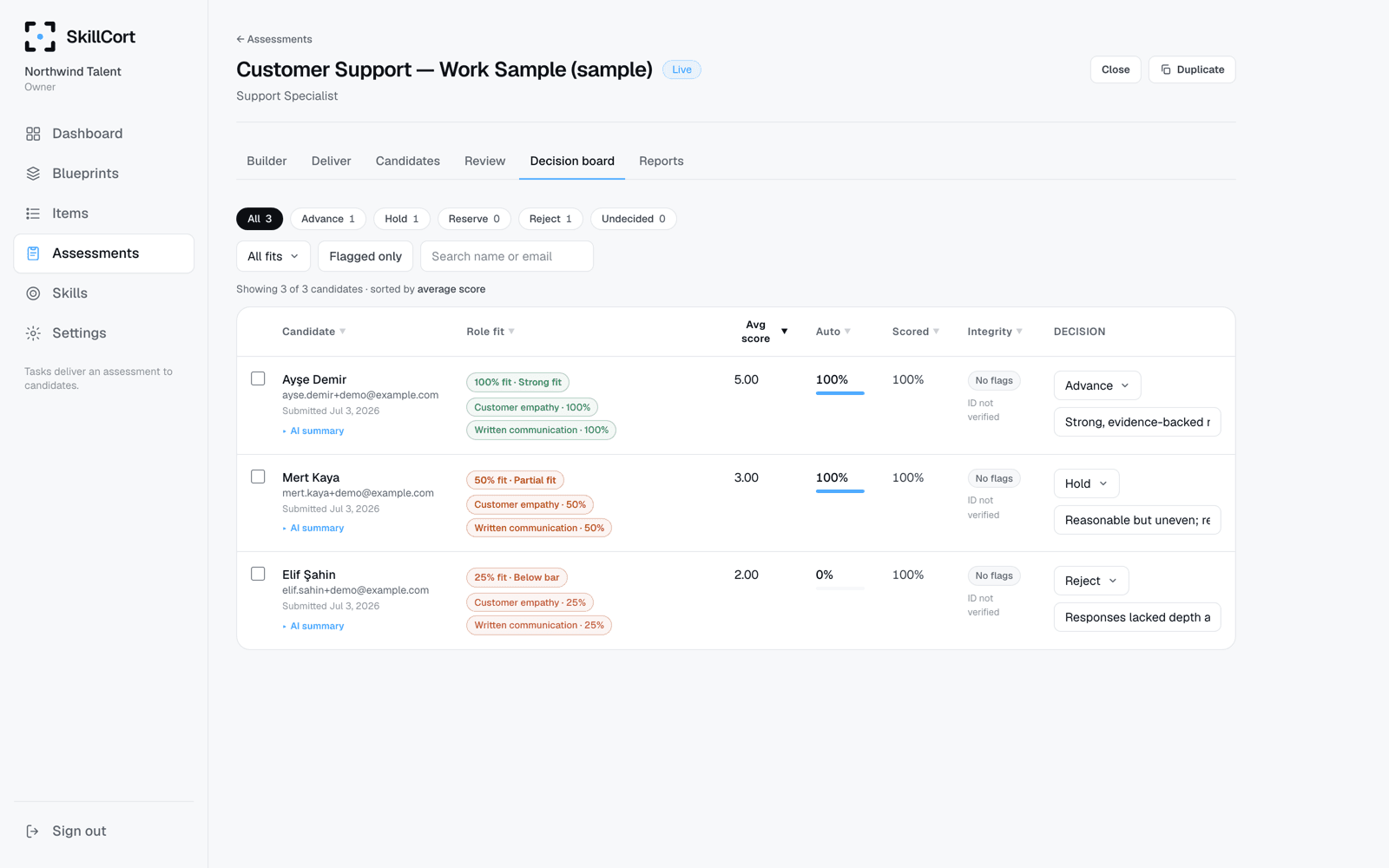
One place to turn evidence into a shortlist
See candidates side by side.
Compare candidates across the same skills, tasks, and rubric criteria, so reviewers weigh the same evidence rather than different impressions.
- Side-by-side candidate view
- Skill-by-skill comparison
- Consistent rubric criteria
- Sortable by skill or score
Map performance to the role.
View each candidate's competency matrix against the role blueprint to see strengths and gaps relative to what the job actually requires.
- Competency matrix per candidate
- Strengths and gaps highlighted
- Weighted against the blueprint
- Explainable, not a black-box score
Open the proof behind every score.
Drill from any score straight into the original task response, evaluator notes, and version history — the candidate's evidence record stays the source of truth.
- Score-to-evidence drill-down
- Original responses and recordings
- Evaluator notes and rationale
- Criteria shown with the source work
Surface risk as context, not verdicts.
Integrity signals appear with their source timeline for reviewer interpretation. They do not independently change a score or candidate status.
- Risk flags for review
- Links to the risk timeline
- Reviewer confirm-or-dismiss resolution
- Resolution retained with the record
Record the call and why it was made.
Record the human-owned outcome and its rationale while the supporting evidence is still open, leaving a clear review trail.
- Decision status with rationale
- Named reviewer attribution
- Decision trail for audit
- Included in reports and data exports
From scattered evidence to one recorded decision.
Instead of weighing submissions, scores, reviewer notes, and integrity findings separately, the Decision Board aligns them to the same role blueprint in one comparison view.
AI-assisted summaries can help reviewers navigate the record, but they do not independently set a candidate's score, status, or final outcome.
About AI-Assisted WorkflowsGather evidence
Pull in tasks, scores, and signals.
Compare candidates
Weigh the same criteria side by side.
Check role-fit
Map strengths and gaps to the role.
Review risk flags
Treat integrity signals as context.
Decide and record
Save the human-owned outcome and rationale.
Everything to make a defensible call
Side-by-Side Comparison
Weigh candidates on the same skills, tasks, and criteria.
Role-Fit Matrix
Map each candidate's strengths and gaps to the role blueprint.
Risk Flags
Surface integrity signals as context for review rather than as a verdict.
Integrity & ProctoringDecision & Rationale
Record the outcome, its reasoning, and the person responsible.
Shared Role Standard
Keep skills, weights, and criteria consistent across the comparison.
Reports & Data Export
Carry the decision record into a printable report or structured export.
Reports & AuditDecision support, with named human ownership.
Scores trace to submitted work, integrity findings remain review context, and the recorded outcome belongs to the person who made it.
- Explainable role-fit, no black box
- Score-to-evidence traceability
- No automatic advance or reject
- Recorded decision rationale
- Named reviewer attribution
- Full audit trail
Frequently asked questions
No. It organizes evidence, scores, role-fit, and integrity context so people can compare candidates. It does not independently select, advance, or reject a candidate.
Role-fit maps each candidate's rubric-scored skills against the role blueprint. It's explainable and traceable to evidence — not a hidden, unexplained score.
Integrity signals appear with the underlying timeline for human review. A reviewer can confirm or dismiss a finding and keep that resolution with the record; the signal does not independently decide the candidate's outcome.
Assigned evaluators can contribute criterion scores and notes in the evaluation workflow. The Decision Board brings that work together, and an authorized owner, admin, or recruiter records the candidate status and decision note.
The candidate report can include the recorded outcome and rationale, and structured assessment data can be exported as CSV or JSON. Reports can be printed or saved as PDF.
Make hiring decisions you can defend.
Bring evidence, role-fit, and risk into one view, and give your team a clear, auditable way to shortlist candidates.