AI-Assisted Workflows
Use AI to assist the work—not make the decision.
Help authors create a starting draft and help reviewers navigate long responses, extracted evidence, and suggestions. The source work stays available, and AI does not independently write the final score or candidate outcome.
AI assists authors and reviewers. Named people own what is published and decided.
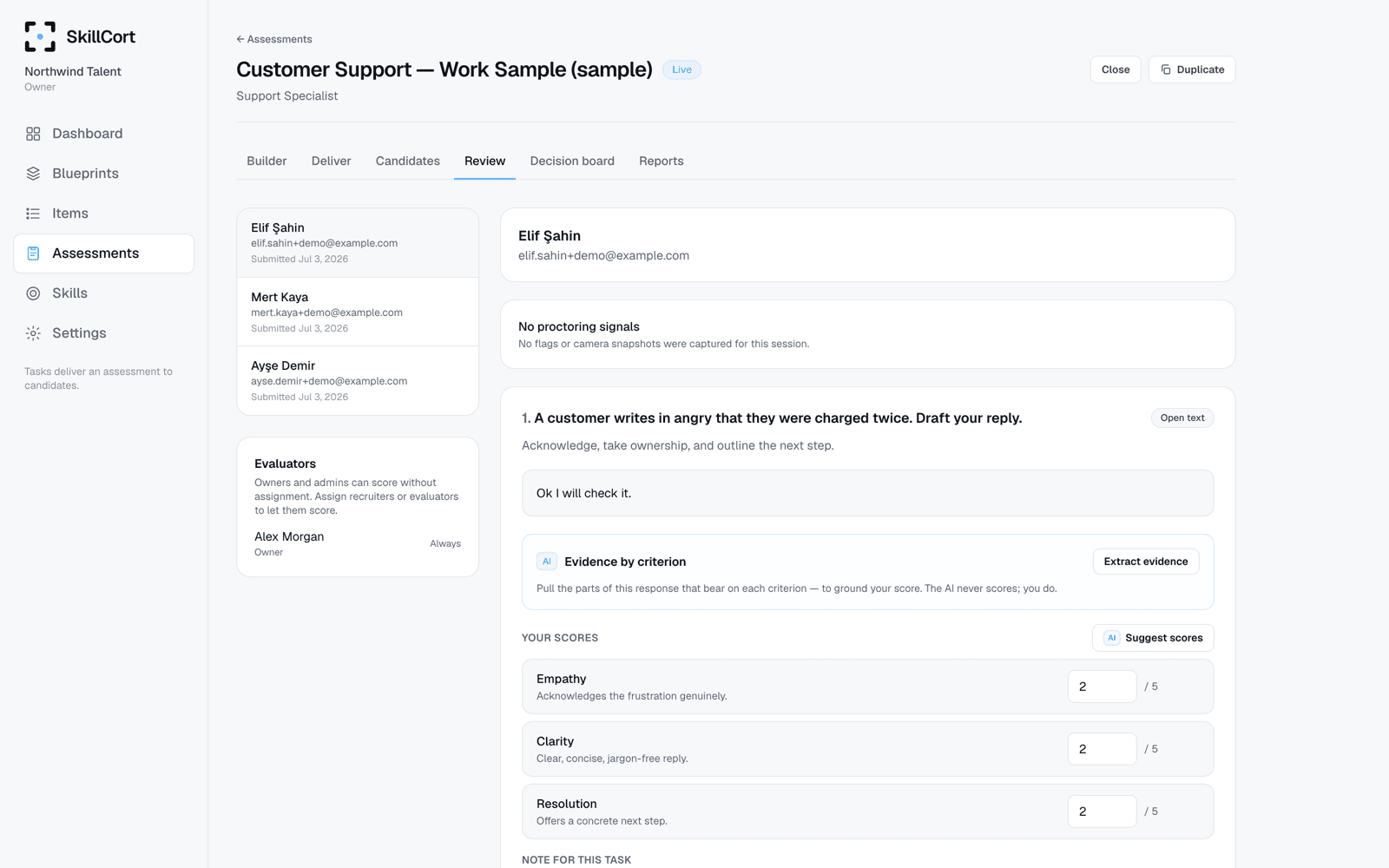
Assistance where authoring and review take the most time
Start from a draft, not a blank page.
AI can suggest task and question drafts from the role and skills an author provides. Authors edit and publish the content they choose to use.
- Role- and skill-informed drafts
- Work-sample and question starting points
- Editable author workspace
- Publishing remains with the author
Turn competencies into draft rubrics.
AI can suggest observable criteria and rating anchors from the skills an author wants to measure. The author can revise the draft before publishing it.
- Competency-to-criteria drafting
- Observable behavior anchors
- Suggested rating scales
- Author-controlled editing and publishing
Read long responses faster.
Summarize long written or spoken responses to help reviewers find the relevant parts faster, with a path back to the submitted response as the source evidence.
- Written and spoken summaries
- Source response available to inspect
- Faster reviewer reading
- Summary separated from reviewer judgment
Point reviewers to rubric-relevant evidence.
AI can organize excerpts and suggestions by rubric criterion so a reviewer can inspect the source, adjust the interpretation, and record the score.
- Criterion-linked evidence excerpts
- Suggested review context
- Source response one step away
- Reviewer-owned scoring
Summarize reviewer notes without hiding their source.
Create a working summary of reviewer notes while keeping the underlying notes and available model provenance connected for inspection.
- Multi-evaluator synthesis
- Source notes preserved
- Model and version logged
- Human-owned outcome
Move faster without separating suggestions from their source.
AI-assisted drafting gives authors a starting point. Summaries and evidence suggestions help reviewers navigate a longer record without replacing the submitted work.
Authors control what gets published. Reviewers inspect the source evidence and remain responsible for the recorded score, rationale, and candidate outcome.
Security & complianceDraft
Create editable task and rubric starting points.
Summarize
Condense long responses for navigation.
Extract
Organize evidence against the rubric.
Inspect
Return to the source response and notes.
Record
A person owns the score and outcome.
AI assistance with clear ownership boundaries
Rubric Drafting
Turn competencies into observable rubric criteria for review.
Response Summaries
Navigate long responses faster, with the source available to inspect.
Evaluation & EvidenceSource Evidence Access
Return from an AI summary or suggestion to the submitted work.
AI Interview Separation
Keep candidate-facing AI interviews distinct from author and reviewer assistance.
AI Interviews & SimulationsModel & Version Logging
Log model and version for transparency and audit.
Human-Owned Outcomes
AI does not independently write the final score or candidate decision.
Security & complianceDecision support, not decision-making.
Black-Box AI Hiring
- Opaque, unexplained fit scores
- Automatic advance or reject
- Hidden behavioral profiling
- No human accountability
SkillCort AI-Assisted Workflows
- Editable drafts under author control
- Summaries linked back to source evidence
- Suggestions organized by rubric criteria
- Available model provenance retained
- Scores and decisions owned by named people
AI helps your team work faster and fairer — the judgment, and the accountability, stay with people.
AI with clear, deliberate limits.
SkillCort uses AI as an authoring and review aid. It helps organize work, while accountability for published content, scoring, and candidate outcomes stays with people.
- No automated reject or advance
- No covert personality or emotion inference
- No cross-client reputation score
- No unexplained fit score
- Source evidence remains available subject to configured retention
- Available model and run metadata retained for audit
Frequently asked questions
No. AI-assisted workflows can draft content, summarize responses, and organize evidence suggestions. They do not independently write the final score, advance or reject status, or recorded decision.
AI summaries link back to the submitted written, spoken, or uploaded response so reviewers can inspect the source, subject to the workspace's configured retention settings.
Candidate-facing AI interviews and simulations are a separate platform capability. This page covers assistance for assessment authors and evidence reviewers.
Authors decide what assessment content to edit and publish. Reviewers decide how suggestions relate to the source evidence and remain responsible for scoring and outcomes.
Source notes are preserved during synthesis, and the model and version used are logged so AI assistance is auditable.
Use AI where it helps. Keep people accountable for the result.
Give authors and reviewers a faster starting point while keeping source evidence, scoring responsibility, and final decisions under human control.